Corpuscule Danse – Dance and Functional Diversity
12 ⇾ Apr. 15 2027 (Monday – Thursday)
10:00 to 13:00
Weekly rate:$80
Drop-in:$28
French, English
Registration will open on Monday, February 1, 2027.
#Somatic #Technique #Toolbox
© Mikaël Theimer
Objective
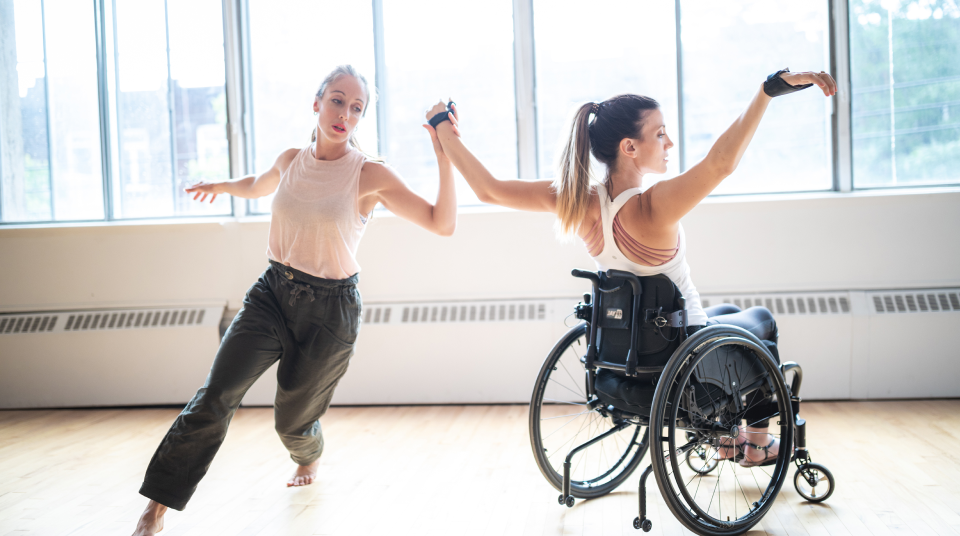
Dance and Functional Diversity is a workshop aimed at demystifying and experiencing dance through an inclusive approach. Following the mission of Corpuscule Danse, the workshop focuses on bringing together dancers with and without disabilities, visible or invisible, to reflect on and explore the practice of inclusive dance.
In a horizontal approach of sharing different perspectives, the workshop will be facilitated by four (4) individuals: Joannie Douville, Élise Hardy, Georges-Nicolas Tremblay, and Jessica Cacciatore, who will strive to demonstrate how they adapt their respective knowledge and skills to foster inclusion.
Content
Concretely, the workshop begins with one (1) hour of theory-guided by various questions posed by both facilitators and participants. What are my individual representations of disability? Which terms should be used to address a group with different modes of functioning? How can dance proposals be translated without compromising quality? How to plan inclusive and fruitful dance situations for everyone and how to adjust in real time? How to articulate constructive feedback and a critical look at inclusive initiatives? Memory aids from the book “An Inclusive Approach to Teaching Dance” will be presented to participants.
This will be followed by two (2) hours of inclusive dance artistic practice where the questions raised will be grounded in each person’s experience. This accessible and supportive practice space will invite us to broaden our perceptions and sensations in movement through improvisation and exploration of the art of being in contact with others and with mobility aids. At the end of this training, participants will be better equipped to reflect on their practice from the perspective of inclusion and accessibility.
Workshop Rhythm
Accessibility Features
Biography
Joannie Douville is a trained dancer and educator with a degree in dance and psychology based in Les Laurentides. For over ten years, she has graced local and international stages and participated in numerous creative processes spanning dance, theater, multimedia arts, and performance. Throughout her career, she has cherished the processes that have led her to eclectic encounters through movement. Whether it’s children, elders, individuals with functional or cultural diversity, Joannie is convinced that dance is for everyone and is a powerful catalyst for creating connections—with oneself and with others. This conviction led her to pursue a master’s degree in dance education. In the same quest, she also co-authored a book to support inclusive dance initiatives in collaboration with Corpuscule Danse titled “An Inclusive Approach to Teaching Dance”. Currently, she cherishes her new role as a mother to her two daughters and directs the teaching and cultural mediation component of Corpuscule Danse: a company for which she has danced, taught, and created since 2012.
Georges-Nicolas Tremblay, a self-taught dancer with a background in visual arts and theater, and a brief foray into cinema, initially established himself as a creator before transitioning into roles as a dancer and, more recently, as a dramaturge. In addition to his personal creations, he has choreographed for theater, operettas, musical comedies, and music videos. During his master’s degree in dance, he became interested in collaboration to renew the artistic process with a desire for de-hierarchicalizing and queering of art, leading him to create “Fé·e·s sans foi” (2024), a hybrid form blending dance and song.
With over 25 years of experience as an educator, he shares his visions of dance through classes, workshops, and cultural mediation, both recreationally and professionally. He also provides audio description for dance (Danse Cité) and co-directs Corpuscule Danse, an inclusive dance company, since 2021.
“A very insightful space for reflection that allows us to address sensitive topics with people living with disabilities, making me more aware of their reality and common misconceptions. It also helps me develop a more accurate vocabulary, a more open-minded approach, and a deeper understanding of my role as a practitioner and educator.”
— Marie-Hélène
Partners
This workshop is supported by the Conseil de la formation continue arts et culture de Montréal (CFC) in collaboration with Studio 303. The CFC’s continuing education activities are supported by the Intervention-Compétences program, thanks to the financial participation of the Quebec government.